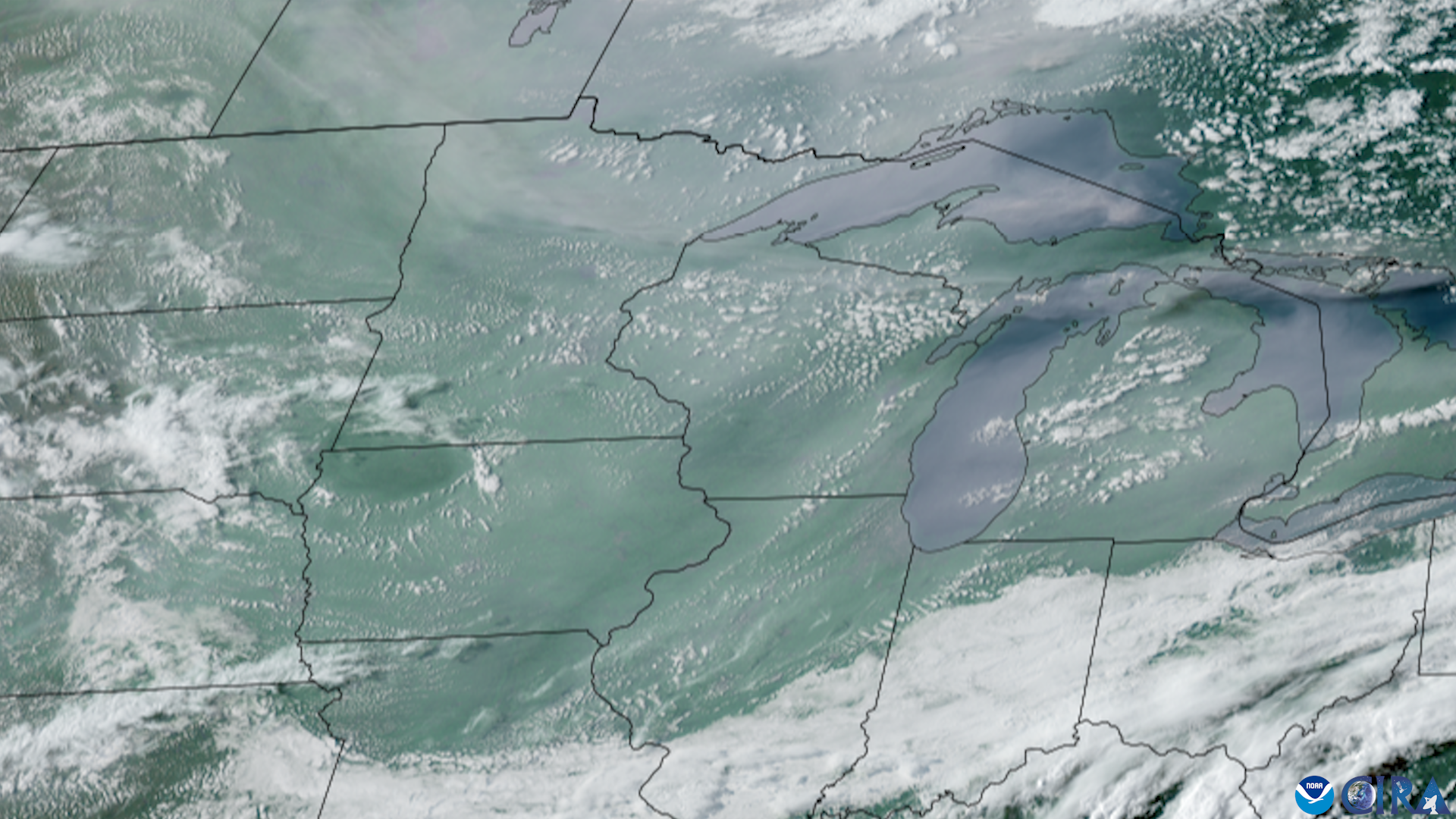
Wildfire smoke drifting south from Ontario and northern Minnesota is forecast to reach the I-88 corridor near Downers Grove by daybreak Thursday, July 16, according to the National Weather Service, pushing air quality into unhealthy territory for people with asthma, heart disease, or other respiratory conditions.
The NWS said its forecast models show smoke stalling near the I-90 and I-88 corridors by early Thursday. The Illinois EPA said the smoke would then gradually expand from the Chicago region toward Rockford throughout the day.
The Illinois EPA declared an Air Pollution Action Day on Tuesday, July 14, for the greater Chicago metropolitan area, warning that ozone and particulate levels were expected to reach or exceed the "Unhealthy for Sensitive Groups" category for multiple days. A broader air quality alert for the Chicago area was in effect through Wednesday night, July 15, with possible extension into Thursday depending on smoke levels.
Current conditions vs. forecast
As of Wednesday afternoon, July 15, DuPage County air quality remained at moderate levels. AirNow.gov data showed Downers Grove Township at an AQI of 54, Downers Grove city at 61, and Westmont at 53. PM2.5 levels stood at 13.7 micrograms per cubic meter countywide.
Thursday's forecast is a different story. The Illinois EPA projects an "orange" AQI rating for the region, meaning conditions would be unhealthy for sensitive groups. Joliet, roughly 20 miles south, is forecast to remain at orange levels through Friday, July 17.
What's driving the smoke
Canada had 835 active wildfires as of Wednesday, July 15, including 112 considered out of control, according to Reuters. Most fires were concentrated in Manitoba, Saskatchewan, and Ontario, with 1.9 million hectares burned this season. The Washington Post reported that an estimated 100 million people across the Midwest, Northeast, and Mid-Atlantic could face unhealthy air quality from Wednesday through Friday.
The air quality problems coincide with the area's second heat wave of the summer. The National Weather Service issued a heat advisory for northeast Illinois with heat indexes expected to reach 100 to 105 degrees on Tuesday and Wednesday. Brett Borchardt, senior meteorologist at the NWS Chicago office, said heat waves and poor air quality frequently coincide, and noted a chance of rain Friday, July 17, could help clear conditions.
Who is most at risk
The Illinois EPA identified sensitive groups as people with asthma or other lung disease, heart disease, children and teens, and older adults. Active children and adults with pulmonary or respiratory conditions should limit prolonged outdoor activity.
Illinois EPA Director James M. Jennings urged residents to build a daily habit of checking forecasts: "We recommend residents get into the habit of checking the daily Air Quality Index at the same time you check the weather each morning, especially if you are part of a sensitive group such as having asthma or another lung disease."
How to protect yourself
If AQI levels rise to "red" (unhealthy for all groups), the Illinois EPA recommends:
- Stay indoors with windows and doors closed
- Set air conditioners to recirculate rather than draw in outside air
- Use high-efficiency filters in AC systems and portable air cleaners
- Avoid indoor activities that create particulate matter, such as smoking or burning candles
- Keep outdoor activities shorter and less intense
- Consider wearing an N-95 or N-100 mask outdoors
Residents can check real-time and forecast air quality at AirNow.gov or through the free AIRNow app.